
The truth about rosemary oil: better than minoxidil for hair regrowth?
Rosemary oil has taken over TikTok, Reddit, and every hair loss forum on the internet. Thousands of people swear it regrew their hair. Some headlines claim it's just as effective or even better than minoxidil, the gold-standard pharmaceutical treatment for hair loss. But how much of this is science, and how much is wishful thinking?
Let's separate the hype from the evidence.
What is rosemary oil and why is it trending?
Rosemary is an aromatic herb whose essential oil has been used in traditional medicine for centuries. Its surge in the hair loss conversation traces back largely to a single clinical study and a wave of social media testimonials that followed.
The active compound driving most of rosemary oil's hair benefits is rosmarinic acid, alongside ursolic acid and carnosic acid. These compounds are believed to improve scalp circulation, reduce inflammation, and inhibit the enzyme 5-alpha reductase. Exactly the same enzyme that converts testosterone into DHT, the hormone responsible for pattern hair loss.
Sound familiar? That's essentially what minoxidil and finasteride do. Through different mechanisms
The study everyone is talking about
The claim that rosemary oil rivals minoxidil originates from a 2015 randomized comparative trial published in SKINmed Journal by Panahi et al. The study compared rosemary oil against 2% minoxidil in 100 patients with androgenetic alopecia over six months.
The results:
- Both groups showed a significant increase in hair count at the six-month mark
- Rosemary oil and minoxidil performed comparably in hair regrowth outcomes
- The rosemary oil group reported less scalp itching than the minoxidil group
This was a legitimate, peer-reviewed study and its findings are genuinely exciting. But context matters enormously.
What the study doesn't tell you
Before you ditch your minoxidil for a bottle of rosemary oil, here's what the research doesn't highlight:
The study used 2% minoxidil, not 5%. The standard clinical dose used today, especially for men, is 5% minoxidil (or the newer 10% formulations). The 2% concentration used in the study is the weaker version, predominantly prescribed for women. Comparing rosemary oil to the stronger formulations used today would likely tell a different story.
The sample size was small. 100 participants over six months is promising, but far from conclusive. Pharmaceutical treatments go through years of large-scale trials before clinical recommendations are made.
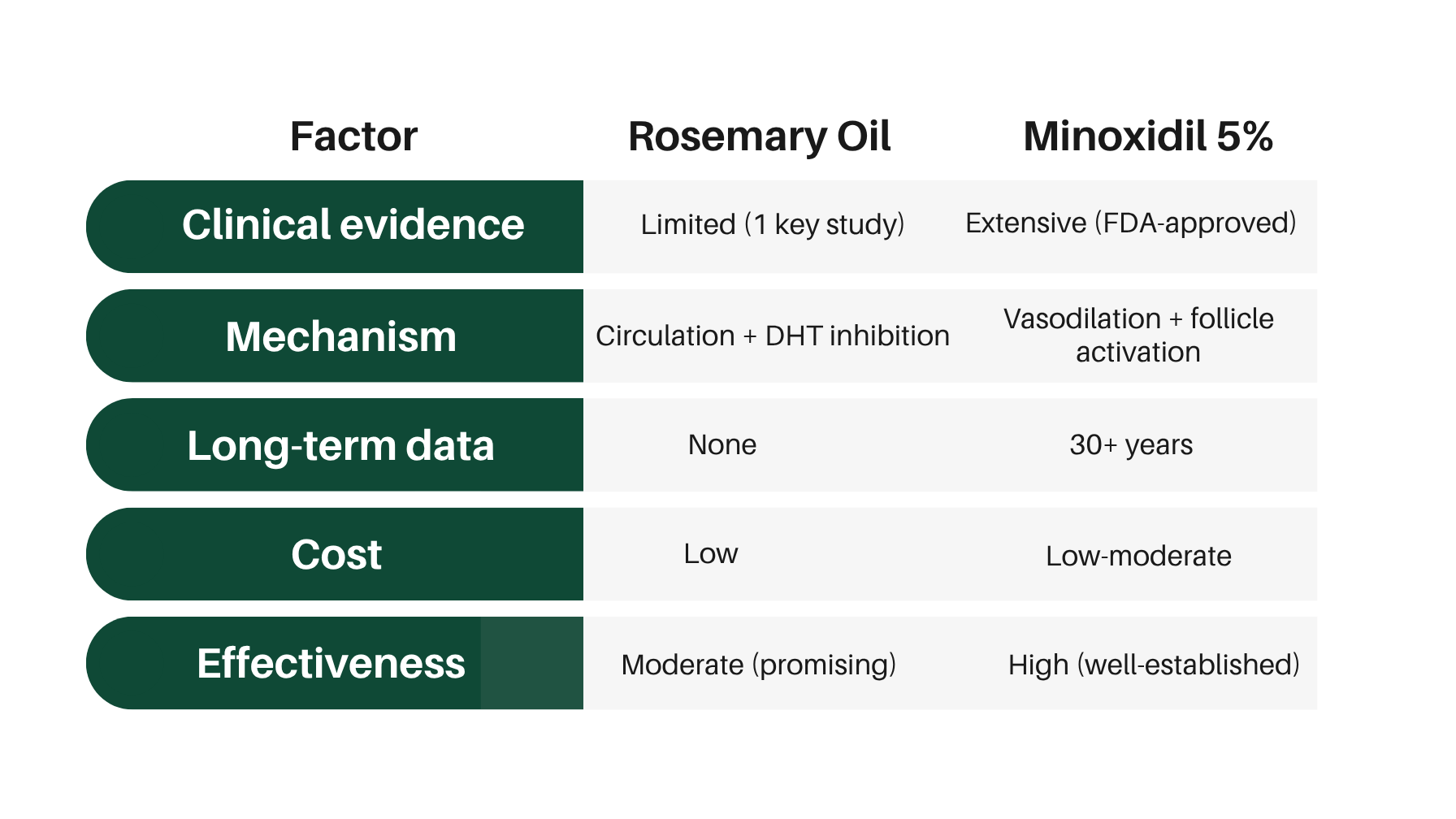
No long-term data exists. Minoxidil has decades of clinical evidence, FDA approval, and long-term efficacy data. Rosemary oil has one notable study and anecdotal reports.
Results varied widely. Averages can be misleading: some participants responded strongly, others barely at all. The same is true for minoxidil, but its consistency across larger populations is far better documented.
How does rosemary oil actually work for hair loss?
Despite the caveats, the mechanisms behind rosemary oil's effectiveness are scientifically plausible:
Improves scalp circulation
Rosemary oil is a vasodilator: it widens blood vessels and improves blood flow to the scalp. Better circulation means follicles receive more oxygen and nutrients, creating an environment more conducive to hair growth. This is a similar mechanism to minoxidil, which was originally developed as a blood pressure medication before its hair growth effects were discovered.
Inhibits 5-Alpha reductase (DHT blocker)
Carnosic acid and ursolic acid in rosemary oil have demonstrated 5-alpha reductase inhibitory activity in lab studies. By reducing the conversion of testosterone to DHT, rosemary oil may slow or reduce follicle miniaturization, particularly relevant for androgenetic alopecia.
Anti-inflammatory properties
Chronic scalp inflammation is a known contributor to hair follicle damage. Rosmarinic acid has potent anti-inflammatory and antioxidant properties that may help create a healthier scalp environment, reducing the oxidative stress that accelerates follicle aging.
Antimicrobial effects
A healthy scalp microbiome matters for hair growth. Rosemary oil's antimicrobial properties may help reduce dandruff, seborrheic dermatitis, and scalp infections: all of which can contribute to hair shedding if left unaddressed.
Rosemary Oil vs. Minoxidil: A Direct Comparison
Who might benefit most from rosemary oil?
Rosemary oil is most likely to be effective for people who:
- Are in the very early stages of hair thinning or loss
- Want a natural complementary treatment to use alongside clinical options
- Are experiencing hair loss related to inflammation or scalp conditions (dandruff, seborrheic dermatitis)
- Are looking for a preventive maintenance option rather than regrowth
It is less likely to be sufficient as a standalone treatment for people with advanced hair loss or significant follicle miniaturization.
The verdict: is rosemary oil better than minoxidil?
No. But it's not nothing, either.
The honest answer is that rosemary oil is a genuinely promising, evidence-backed natural treatment that holds real value in a comprehensive hair loss strategy. But calling it "better than minoxidil" overstates the evidence significantly.
What the science actually supports:
- Rosemary oil can meaningfully reduce hair shedding and modestly improve hair density
- It works through legitimate biological mechanisms, not just placebo
- It is a well-tolerated, low-risk option with a favorable side effect profile
- It is best used as part of a multi-pronged approach, not as a sole treatment
The most effective approach to hair loss, whether caused by genetics, lifestyle, or hormones, combines multiple evidence-based strategies targeting different mechanisms simultaneously.
A smarter approach to hair regrowth
At Headin, we believe in using the full toolkit. Our formulations are built on clinical science: incorporating proven actives that target scalp circulation, DHT blockade, and follicle activation — so you're not relying on a single ingredient to do all the heavy lifting.
Whether you're curious about natural options, looking to move beyond minoxidil, or just starting your hair loss journey, Headin is designed to deliver real, measurable results without the guesswork.
.svg)