
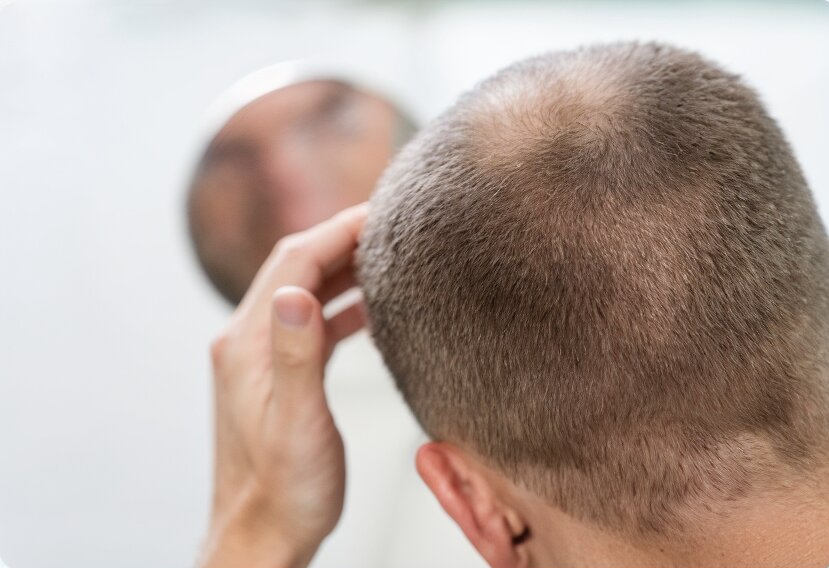
For a long time, the conversation around male pattern baldness was essentially about damage control. Slow it down, accept what you can't change, and make peace with the rest. That framing is becoming genuinely outdated.
Research into androgenic alopecia has accelerated significantly over the past few years. Scientists now understand the biological mechanisms driving hair loss in more detail than ever before, and that understanding is producing treatment approaches that go well beyond what was available even a decade ago. The goal is no longer just slowing the inevitable. For a growing number of men, it's stopping and reversing it.
What actually causes male pattern baldness
Androgenic alopecia is a genetically determined condition in which hair follicles progressively shrink over time, producing finer and shorter hairs until they eventually stop producing hair altogether. The process typically follows a recognizable pattern, recession at the temples, thinning at the crown, and gradual spread from both areas, though the rate and extent vary considerably between individuals.
The primary driver is dihydrotestosterone, or DHT, a potent androgen derived from testosterone through the action of an enzyme called 5-alpha reductase. In men who are genetically predisposed to hair loss, follicles in specific areas of the scalp carry a high concentration of DHT-sensitive receptors. When DHT binds to these receptors, it progressively shrinks the follicle and shortens the hair growth cycle. Each successive cycle produces a slightly weaker, thinner strand until the follicle becomes dormant.
This is why pattern baldness affects the crown and temples while the sides and back of the head remain largely unaffected. The follicles in those areas simply don't carry the same receptor sensitivity, which is also why hair transplant surgery works: follicles taken from the sides and back retain their DHT resistance after being moved to the balding areas.
The genetic component draws from both sides of the family, not just the maternal line. Multiple genes across different chromosomes influence DHT metabolism and receptor sensitivity, which is why hair loss patterns don't always mirror what happened to a father or maternal grandfather exactly.
Where the science is heading in 2026
The treatments available right now are meaningfully effective, and they're discussed below. But the more interesting development is how rapidly the research landscape has shifted toward regeneration rather than just preservation.
More targeted DHT inhibition
The established DHT blockers work systemically, which is effective but also why some men experience side effects related to hormonal changes. Current research is focused on precision: highly targeted topical formulations that reduce DHT specifically at the follicle level in the scalp without significant absorption into the broader system. Advanced topical finasteride formulations with improved scalp penetration are already emerging from this work, and novel molecules designed to block the DHT receptor directly at the follicle site are in development.
Stem cell and follicle regeneration
Probably the most significant frontier in hair loss research right now is the potential to regenerate follicles rather than just preserve existing ones. Early clinical trials exploring stem cell therapies have shown genuine promise in reactivating dormant follicles, and some research is investigating the possibility of creating new follicles entirely. This is still in relatively early stages, but the trajectory is meaningful. The distinction from existing treatments is that this would address hair loss at its source rather than managing its progression.
Exosome therapy
Exosomes are small signaling vesicles produced by stem cells that carry growth instructions between cells. Researchers are now harnessing these to deliver targeted growth signals directly to the follicle environment, stimulating repair, improving local blood flow, and extending the active growth phase. Early clinical results are promising, and the treatment is already being offered in some specialist clinics as an alternative or complement to platelet-rich plasma therapy. The proposed advantage over PRP is that exosomes act at a deeper cellular level and may produce more durable results.
Low-level laser therapy
Laser and red light devices for scalp use have accumulated a reasonable body of clinical support over the past several years. They work by stimulating mitochondrial activity within follicle cells, effectively improving the cellular energy available to support hair growth. What's newer in this space is the application of AI-driven devices that use scalp imaging to customize light patterns and treatment protocols for individual users, moving away from the one-size-fits-all approach of earlier devices.
Epigenetic and gene-editing research
The longer-term horizon involves modifying the genetic expression that makes follicles sensitive to DHT in the first place. CRISPR-based approaches and other gene-editing tools are being explored as a potential path to switching off the DHT sensitivity pathway permanently. This is genuinely early-stage research and not a near-term clinical option, but it represents a direction the field is taking seriously.
What works right now
The emerging science is worth knowing about, but for anyone dealing with hair loss today, the priority is the treatments with established clinical track records.
Finasteride remains the most effective pharmaceutical option for stopping androgenic alopecia in its tracks. By blocking 5-alpha reductase, it reduces DHT production and removes the primary hormonal pressure on the follicle. Studies consistently show it halts progression in the majority of men who take it and produces measurable regrowth in a significant proportion. It's available in oral and topical forms, with topical formulations offering reduced systemic exposure for men concerned about side effects.
Minoxidil doesn't address DHT but works through a complementary mechanism, improving scalp circulation and extending the anagen phase to encourage miniaturized follicles to produce thicker, more robust hair. Used alongside finasteride, the combination targets both the hormonal cause and the growth environment simultaneously, producing better outcomes than either treatment alone.
Low-level laser therapy, PRP, and exosome treatments serve as useful adjuncts to the core pharmacological approach rather than standalone solutions. Microneedling improves topical drug absorption and has some independent evidence for improving hair density. Hair transplant surgery remains the most definitive option for men with more advanced loss, using DHT-resistant follicles from the sides and back to restore coverage in balding areas.
The single factor that most determines how well any of these treatments work is timing. Follicles that are miniaturized but still alive respond to treatment. Follicles that have been dormant for years are significantly harder to reactivate, and completely destroyed follicles cannot be recovered through any currently available non-surgical method. Acting at the first signs of thinning preserves the most options.
The bigger picture
Male pattern baldness is common, well-understood, and increasingly well-treated. Science has moved from managing an inevitable decline to genuinely intervening in the biological process driving it. That shift matters practically because it means men who act early have a realistic chance of maintaining most of their hair, not just slowing its loss.
If you're noticing the early signs, that's the right time to take it seriously.


.png)
.svg)