

You're looking in the mirror and something feels different. Your hairline looks higher than it did a few years ago, or maybe it's always been like this and you just never noticed. You pull up an old photo and squint. Is that normal? Is that... balding?
For men in their late twenties, thirties, and beyond, this is one of the most common and most anxiety-inducing hair questions there is.
Here's the truth: not every hairline change is a sign of hair loss. Some are completely normal. Others are the early stages of male pattern baldness. And the difference between the two matters enormously, because the action you take (or don't take) right now determines a lot about what your hair looks like in five or ten years.
This guide breaks it all down.
What is a mature hairline?
A mature hairline is a natural, permanent shift in where the hairline sits on the forehead, and it's something that happens to the majority of men.
Most boys and young men have what's called a juvenile hairline: a hairline that sits very low on the forehead, often with rounded, full corners. As men move through their late teens and twenties, this juvenile hairline naturally rises and reshapes. The corners round off slightly, the hairline moves back roughly one to one and a half centimeters from its original position, and the overall shape may go from fully rounded to slightly more defined.
This process is called hairline maturation, and it's not hair loss. It's a normal developmental change, the same way your face changes shape between your teens and your thirties.
The critical characteristic of a mature hairline is that once it settles, it stays. It doesn't keep moving. It doesn't get thinner. It's simply a more "adult" version of your hairline, one that sits slightly higher and has slightly more defined corners than it did at 18.
What is a receding hairline?
A receding hairline is an ongoing process of hair loss driven by male pattern baldness (androgenetic alopecia). Unlike a maturing hairline, it doesn't stop on its own. Without treatment, it continues to advance.
The cause is DHT, a hormone derived from testosterone. In men who are genetically sensitive to DHT, it binds to hair follicles at the temples and hairline and causes them to gradually miniaturize, producing thinner, weaker hair until they eventually stop producing hair altogether.
A receding hairline typically starts at the temples, creating an M-shaped recession that deepens over time. Left untreated, it progresses, usually in line with the Norwood scale, toward the crown and the top of the scalp.
The key characteristic of a receding hairline is that it keeps moving. It doesn't plateau at a new position. It advances.
Mature hairline vs. receding hairline: the key differences
Understanding the difference comes down to five things: the pattern of change, the speed of change, the texture of remaining hair, whether it's accompanied by crown thinning, and family history.
Pattern of change
A mature hairline recedes relatively evenly across the entire front of the hairline. The corners may become slightly more defined, but the overall shape remains balanced and relatively uniform.
A receding hairline tends to recede unevenly, most noticeably at the temples first, creating that distinctive M-shape. If your recession is concentrated at the temples and the very front of the hairline, that's a stronger signal of pattern baldness than an even, overall shift backward.
Speed of change
A mature hairline change typically happens gradually over a few years in a man's late teens to mid-twenties, and then stops. If you're 35 and your hairline has been visibly moving for the past two years, that's not maturation. That's recession.
Hair texture and density
This is one of the most reliable tells. Run your fingers through your hair along the hairline. A maturing hairline produces hair of normal texture and density — just in a slightly different position.
A receding hairline is often accompanied by hair that is visibly finer, shorter, or lighter in color along the hairline and temples. These are miniaturizing hairs, the early product of follicles being affected by DHT. If the hairs at your hairline look or feel different from the hair behind them, that's a meaningful sign.
Crown thinning
A mature hairline does not affect the crown. If you're also noticing thinning or reduced density at the top or back of your head, that's a clear sign you're dealing with pattern baldness, not maturation.
Family history
Androgenetic alopecia is strongly hereditary. If your father, maternal grandfather, or uncles experienced significant hair loss, your risk is meaningfully higher. Family history doesn't guarantee hair loss, but it changes how you should interpret the changes you're seeing.
How to check your own hairline
You don't need to see a doctor to do an initial self-assessment. Here's a practical method:
Step 1: Find an old photo.Look for a photo from your late teens or early twenties — ideally one where your hair is pulled back or your forehead is visible. Compare the position and shape of your hairline then versus now.
Step 2: Look at the shape, not just the position.Has the overall hairline moved back evenly, or is the recession concentrated at the temples? An M-shape forming at the temples is a more concerning sign than an even backward shift.
Step 3: Examine the hair quality at the hairline.In good lighting, look at the hairs along your hairline and temples. Are they the same thickness and color as the hair further back on your scalp? Fine, light, or shorter hairs at the hairline suggest miniaturization.
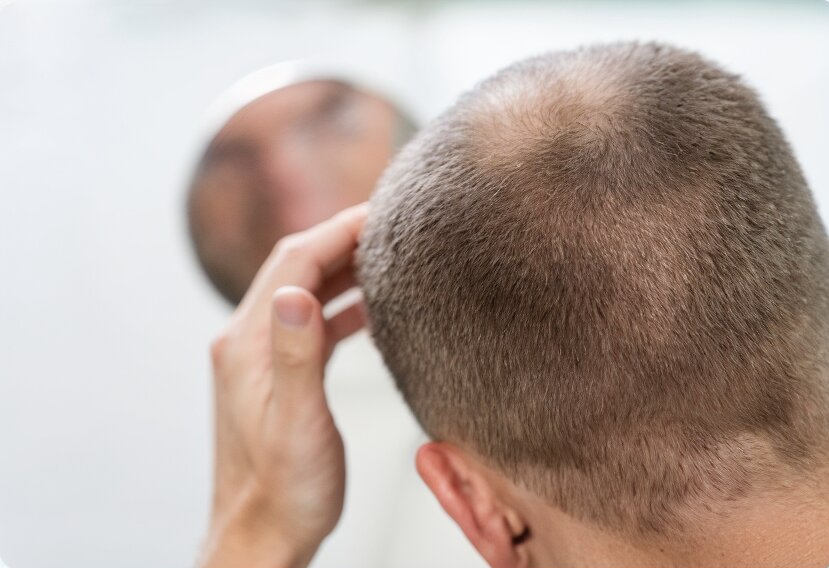
Step 4: Check the crown.Tilt your head forward under a bright light or take a photo from above. Any visible thinning at the crown alongside hairline changes should be taken seriously.
Step 5: Track it over time.Take a photo in consistent lighting today. Take another in three months. If the hairline has visibly moved, you have your answer.
The widow's peak question
Many men confuse a widow's peak with a receding hairline, and it's a reasonable source of confusion, because the shapes can look similar.
A widow's peak is a genetic trait where the hairline dips to a natural point at the center of the forehead. It's present from birth (or becomes apparent in early childhood) and has nothing to do with hair loss. Men with widow's peaks can still develop a receding hairline. The peak will simply recede along with the rest of the hairline, but the peak itself is not a sign of baldness.
If you've always had a prominent widow's peak, it's not a cause for concern. If a widow's peak shape has appeared where your hairline was previously straighter, that's worth paying attention to.
What to do if it's a maturing hairline
If you've assessed the signs and you're confident what you're dealing with is normal maturation, your hairline shifted in your early-to-mid twenties, it's been stable since, your hair texture is normal, and there's no crown thinning, then the honest answer is: nothing, unless you want to.
A mature hairline is not a medical concern. It doesn't require treatment. Many men find that a slightly higher, more defined hairline actually suits their face better as an adult than the juvenile hairline they had at 18.
That said, if you have a family history of pattern baldness and you want to be proactive, speaking with a doctor about preventive options is completely reasonable. Finasteride is sometimes prescribed to men with strong genetic risk even before visible loss begins.
What to do if it's a receding hairline
If the signs point toward recession, the M-shape is forming, hair at the temples feels finer, the change has been ongoing, the most important thing you can do is act early. Hair loss treatment is dramatically more effective when there are still follicles to protect.
Finasteride
Finasteride is an oral prescription medication that works by blocking the enzyme that converts testosterone into DHT. By reducing DHT levels in the scalp, it slows or halts the miniaturization process. Clinical studies show that finasteride stops further hair loss in the majority of men who use it, and many see some regrowth.
It requires a prescription and takes 3 to 6 months to show visible results. It must be taken consistently. Stopping treatment typically leads to resumed hair loss within 6 to 12 months.
Minoxidil
Minoxidil is available over the counter as a topical solution or foam, and increasingly as a low-dose oral medication prescribed off-label for hair loss. It works by increasing blood flow to hair follicles and extending the growth phase of the hair cycle.
Minoxidil is particularly effective at the temples and hairline when used in the early stages of recession. Used alongside finasteride, the combination is more effective than either treatment alone.
Lifestyle factors
While lifestyle changes alone won't stop pattern baldness, they create a better environment for treatment to work. Chronic stress elevates cortisol, which can worsen hair shedding. Poor nutrition, particularly low protein, iron, or zinc intake, can compromise hair quality. Adequate sleep and a nutrient-dense diet support follicle health.
The bottom line
The difference between a mature and receding hairline comes down to one question: is it still moving?
A mature hairline settles. A receding hairline progresses.
If yours has stabilized, the same position for several years, normal hair texture, no crown changes, you're almost certainly looking at maturation. If it's been shifting, the hairs at the temples feel finer, or you're seeing changes in the crown too, you're likely dealing with early pattern baldness.
Either way, knowing the difference gives you clarity. And if it is recession, knowing early means your options are at their best. The men who maintain the most hair into their forties and fifties aren't the ones with the best genetics. They're the ones who paid attention and acted while they still had something to protect.
Think It Might Be Recession? Don't Wait to Find Out.
If anything in this article sounded familiar, your next move matters.
Headin's hair regrowth serum combines 8% minoxidil and finasteride into one simple daily formula. Minoxidil gets to work on the follicles, finasteride tackles the DHT driving the recession, and together they give you the best chance of holding onto what you have and getting some of it back.
The earlier you start, the better it works. That's not a sales line, it's just how hair loss biology works.
Take Headin's free 2-minute hair quiz to find out if your hairline is maturing or receding, and whether our serum is the right fit for where you're at right now.


.png)
.svg)