
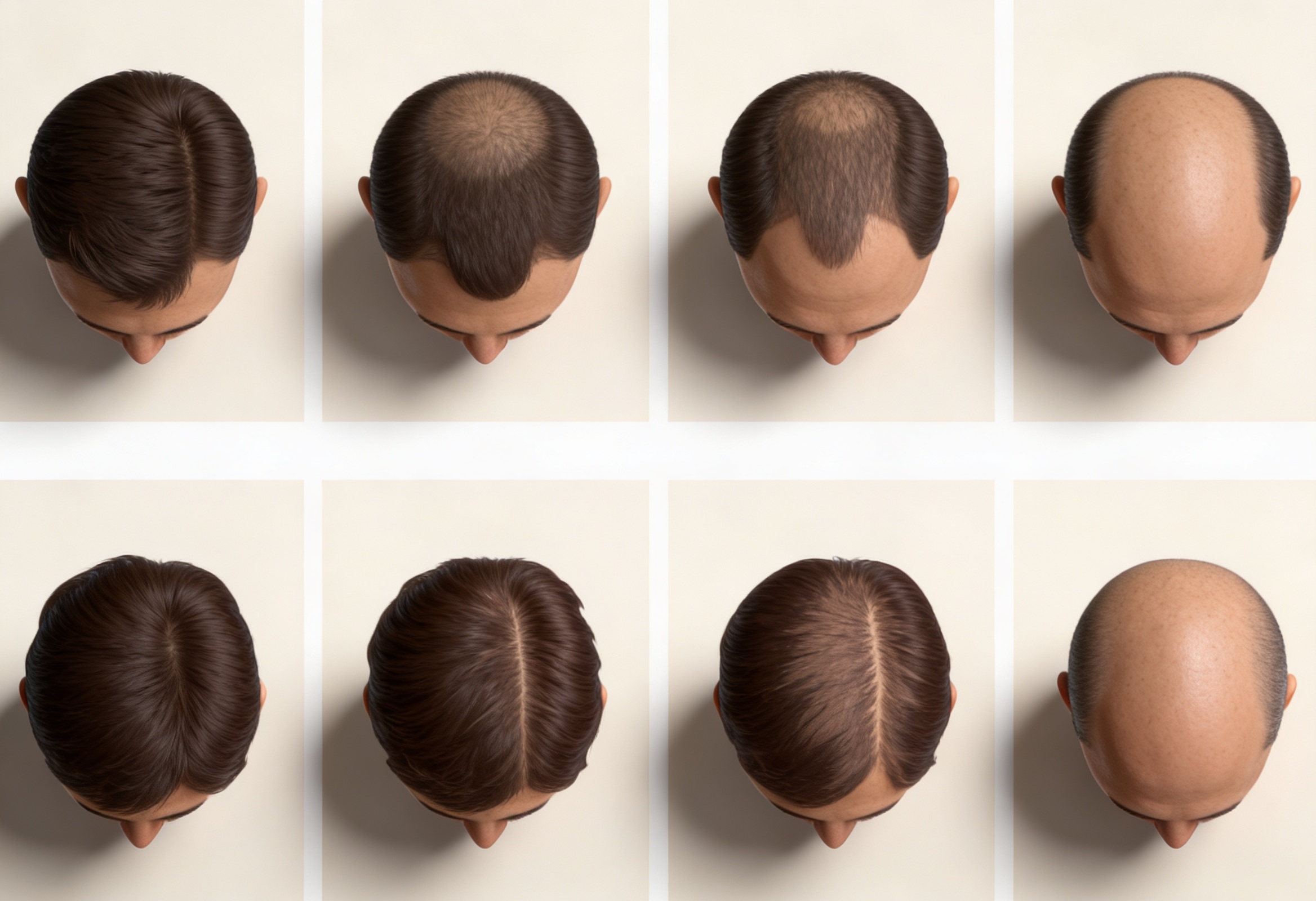
You've noticed your hair changing. Maybe the temples look a little more open than they used to, or the crown isn't as thick as it was in your twenties. You've heard the term "male pattern baldness" — but what does that actually mean for you, right now, at this specific stage of hair loss?
That's exactly what the Norwood scale is for.
Developed in the 1950s and refined by dermatologist Dr. O'Tar Norwood in the 1970s, the Norwood scale is the gold standard classification system for male pattern baldness. It maps hair loss into seven distinct stages — from a full head of hair to advanced baldness — and gives both doctors and patients a shared language for understanding where things stand and where they're headed.
But most articles just describe the stages. This one goes further: at each stage, we'll tell you what's actually happening, what your options are, and what you should do next.
Why male pattern baldness follows a pattern
Before diving into the stages, it helps to understand why hair loss in men follows a predictable path at all.
The cause is a hormone called dihydrotestosterone — DHT. In men who are genetically sensitive to it, DHT binds to receptors in hair follicles on the scalp, causing them to shrink over time in a process called follicular miniaturization. Smaller follicles produce thinner, shorter, lighter hairs until eventually they stop producing hair altogether.
DHT doesn't affect all follicles equally. Follicles at the temples and crown are far more sensitive to it than those at the back and sides of the head — which is why the horseshoe pattern of hair loss that many bald men have (hair remaining only at the sides and back) looks the way it does. Those follicles are simply DHT-resistant.
The Norwood scale tracks exactly this progression — from the first signs of DHT-driven recession all the way through advanced loss.
Norwood Stage 1: no significant hair loss
At Stage 1, there is no noticeable hair loss or hairline recession. Your hairline sits where it always has, with full density across the scalp.
What's happening: Your follicles are healthy and producing terminal hair normally. There may be some minor DHT sensitivity, but it hasn't yet manifested as visible loss.
What you should do: Nothing urgent but if you have a family history of male pattern baldness, this is the ideal time to be proactive. Starting a DHT-blocking treatment like finasteride now, before any loss occurs, is the most effective way to preserve what you have.
Norwood Stage 2: early recession at the temples
Stage 2 is where most men first notice something is happening. The hairline begins to recede slightly at the temples, creating a subtle triangular recession on each side. The overall hairline remains relatively intact and you'd likely need side-by-side photos from a few years ago to confirm the change.
This is also the stage most commonly confused with a maturing hairline (more on that distinction later in this article).
What's happening: DHT is beginning to miniaturize follicles at the temples. The recession is mild, but the process is underway.
What you should do: This is an excellent stage to begin treatment. Finasteride has the strongest evidence base for slowing and stopping DHT-driven hair loss, and minoxidil can support regrowth in thinning areas. Starting at Stage 2 gives you the best chance of maintaining your hairline long-term. Don't wait until the loss is obvious.
Norwood Stage 3: obvious recession — the point of no ignoring it
Stage 3 is the minimum level that most dermatologists classify as clinical baldness. The hairline has receded noticeably at the temples, forming a clear M or V shape. The recession is deep enough that it's visible in any lighting, and harder to conceal with styling.
Some men at Stage 3 also experience early thinning at the crown (vertex) — this is classified as Stage 3 Vertex, and it signals that loss is progressing on two fronts simultaneously.
What's happening: Follicular miniaturization is well established at the temples. If crown thinning is present, DHT sensitivity is more widespread than just the frontal hairline.
What you should do: Stage 3 is the critical intervention window. Hair loss is visible, but there's still a lot to protect. A combination of finasteride and minoxidil — the two most clinically proven treatments available — gives you the best odds of halting progression and potentially recovering some density. If you haven't spoken to a doctor yet, now is the time.
Men at Stage 3 Vertex should be particularly aggressive about treatment, as dual-front progression tends to advance faster.
Norwood Stage 4: significant loss at hairline and crown
At Stage 4, hair loss at the temples has progressed significantly, and a bald patch at the crown is now clearly visible. A band of hair still separates the two areas of loss, but the overall appearance is unmistakably that of a man experiencing pattern baldness.
Hair density across the top of the scalp is noticeably reduced. Styling can no longer conceal what's happening.
What's happening: DHT has caused widespread miniaturization across the frontal scalp and crown. The remaining hair between these areas (the "bridge") is also likely thinning.
What you should do: Finasteride and minoxidil remain the frontline treatments, and can still be effective at Stage 4, particularly for slowing further loss and potentially thickening the bridge of remaining hair. Some men at this stage also begin exploring low-level laser therapy as a complementary treatment.
Hair transplant consultation is worth considering, not necessarily for immediate action, but to understand your options and donor hair availability while you still have good density at the back and sides.
Norwood Stage 5: the bridge begins to disappear
Stage 5 represents a significant escalation. The band of hair separating the frontal hairline and crown loss is now thin and narrow, barely visible in some cases. From above, the two areas of baldness are clearly merging into one large bald zone.
Hair loss at this stage is obvious and extensive. Remaining hair sits primarily at the back and sides of the scalp.
What's happening: The "bridge" follicles are now miniaturizing. DHT sensitivity has effectively spread across the entire top of the scalp.
What you should do: Medical treatments can still slow further progression, stopping complete loss is a meaningful outcome even at this stage. However, many men at Stage 5 begin seriously evaluating hair transplant surgery. A skilled surgeon can redistribute healthy, DHT-resistant follicles from the donor area to the thinning regions. The key constraint is donor hair availability, which is why earlier consultation is valuable.
Norwood Stage 6: severe hair loss
At Stage 6, the bridge between frontal and crown loss has largely or entirely disappeared. There is now one large bald area covering most of the top of the scalp. The characteristic horseshoe pattern of remaining hair at the back and sides of the head is clearly visible.
What's happening: Advanced follicular miniaturization has affected the vast majority of the scalp's top surface. The remaining hair follicles in the bald zone are producing little to no visible hair.
What you should do: Medical treatments at this stage have limited impact on the bald zones — those follicles are essentially dormant. The focus shifts to maintaining the existing hair at the back and sides, and evaluating whether a hair transplant is viable given your donor hair supply.
Some men at Stage 6 choose to embrace the look, closely cropping or shaving the remaining hair to create a more uniform appearance. This is a completely valid choice, and for many men it looks better than attempting to preserve the remaining hair.
Norwood Stage 7: the most advanced stage
Stage 7 is the most severe form of male pattern baldness. At this stage, only a narrow horseshoe of hair remains around the back and sides of the head. Even this remaining hair may be thin and fine. The top, front, and crown of the scalp are entirely bald.
What's happening: DHT has effectively ended hair production across nearly the entire scalp surface. The remaining follicles at the back and sides are DHT-resistant — they will continue producing hair indefinitely.
What you should do: Hair transplant surgery at Stage 7 requires careful planning — the donor supply must cover a very large recipient area, which limits what's achievable. Some men opt for scalp micropigmentation, a non-surgical cosmetic procedure that uses tiny pigment deposits to simulate the appearance of a shaved head with natural hairline definition. Shaving the head completely is also a popular choice that many men find liberating rather than limiting.
How to figure out your Norwood Stage
Self-assessment is possible with a few simple steps:
- Take photos in consistent, bright lighting — overhead lighting is best for showing scalp visibility.
- Photograph from above, front, and each side.
- Compare to reference images of each Norwood stage — be honest with yourself. Men often underestimate their stage.
- Track changes over time — a single photo is a snapshot. Photos taken 6 months apart reveal whether loss is progressing.
If you're unsure, a dermatologist or trichologist can assess your stage professionally, sometimes using a dermatoscope to examine follicle health below the surface.
The mMost important thing about the Norwood Scale
The scale isn't just a classification system — it's a roadmap for decision-making. Every stage has options. The earlier you act, the more of those options are available to you.
Hair loss medications like finasteride work best when there are still follicles to protect. Minoxidil works best when there are still follicles to stimulate. Hair transplants work best when there's still a healthy donor supply.
Waiting doesn't make any of these easier. It makes all of them harder.
If you've been watching your hair change and telling yourself you'll deal with it later, the Norwood scale is telling you that later has a cost.
Not Sure Where You Stand? Start Here.
Reading about the Norwood scale is one thing. Knowing your own stage and what to do about it is another.
If you've been noticing changes in your hairline or crown and you're not quite sure what's going on, our free hair quiz takes less than 2 minutes and gives you a clear picture of where you're at. Based on your answers, we'll match you with a clinician-approved treatment plan built around your stage, your goals, and what's actually realistic for your hair.
No guesswork. No pressure. Just a straightforward starting point.
Take the Hair Quiz and Find Your Treatment Plan






.svg)