
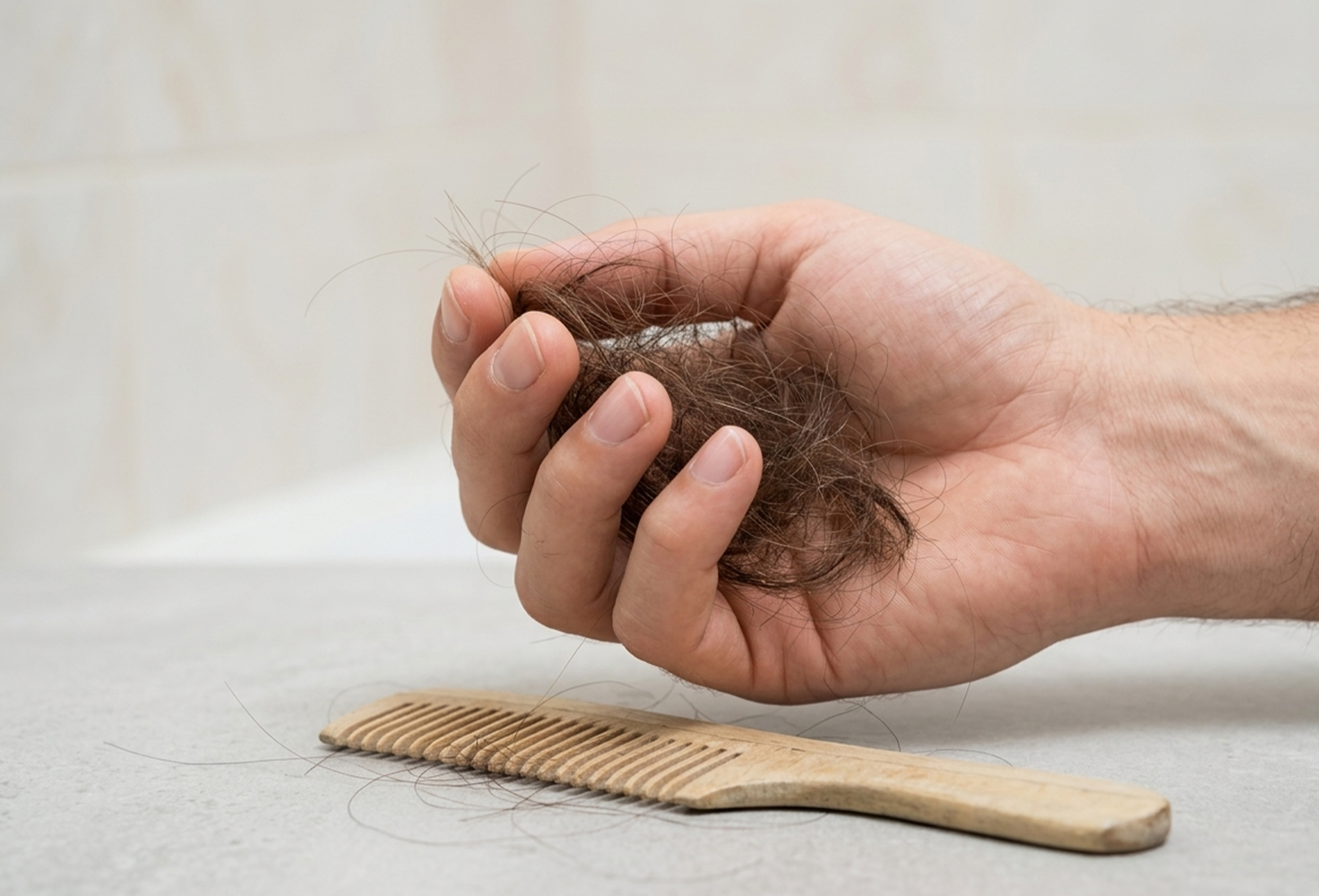
You started minoxidil to stop your hair from falling out. So why is more hair suddenly ending up on your pillow, in the shower drain, and on your hairbrush?
If this sounds familiar, you're not alone, and you're not going backward. What you're experiencing is called the minoxidil shed, and it's one of the most misunderstood phases of hair loss treatment. In fact, it's often the reason people quit too early and miss out on real, lasting results.
This guide covers everything you need to know: what the minoxidil shed is, why it happens, how long it lasts, and exactly when to be concerned.
What is the minoxidil shed?
The minoxidil shed (sometimes called the "dread shed") is a temporary increase in hair loss that occurs shortly after starting minoxidil treatment. It can feel alarming, but it's a well-documented clinical phenomenon and, for many people, a sign that the medication is beginning to work.
Rather than your hair getting worse, what's actually happening is a biological reset. Minoxidil forces dormant, weakened hairs into the shedding phase so that your follicles can begin a new, stronger growth cycle.
The science behind the shed: understanding your hair growth cycle
To understand why the minoxidil shed happens, you need to understand how your hair grows. Hair goes through four distinct phases:
1. Anagen (growth phase) This is when your follicle actively produces new hair. It lasts anywhere from 2 to 7 years and accounts for roughly 85-90% of your hair at any given time.
2. Catagen (transition phase) A brief 1-2 week phase where hair follicles shrink and detach from the blood supply. About 1-3% of follicles are in this phase at once.
3. Telogen (resting phase) Hair follicles become dormant for roughly 12 weeks. Around 10–15% of your follicles are resting at any given time. In androgenetic alopecia (AGA), this phase is abnormally prolonged, meaning more hairs sit idle for longer — one reason thinning becomes visible.
4. Exogen (shedding phase) The old hair strand is released and pushed out as the follicle prepares to re-enter the anagen phase. Losing 50-100 hairs per day is completely normal.
Why does minoxidil cause shedding?
Minoxidil works by shortening the telogen (resting) phase and accelerating the transition back into anagen (active growth). Here's the catch: to launch into a new growth cycle, the follicle first has to shed the old, resting hair.
In people with AGA, there are often an abnormally large number of follicles stuck in the telogen phase at the same time. When minoxidil kicks in, it essentially sends a signal to all of those resting hairs at once: it's time to go. Instead of shedding gradually over weeks or months, they shed in a compressed window.
This mechanism is known clinically as "immediate telogen release", which produces the noticeable spike in shedding. Research on animal models found that topical minoxidil can shorten the telogen phase from 20 days down to just 1=2 days, which explains the sudden rush of hair loss.
Importantly, these are hairs that were already on their way out. Minoxidil isn't damaging healthy follicles. It's just speeding up the departure of hairs that would have shed anyway.
8% Minoxidil Shed Timeline: What to Expect Week by Week
Everyone's experience is slightly different, but here's what to expect when using headin.co's serum containing 8% compounded topical minoxidil — a higher-concentration formulation prescribed to patients who need a more targeted approach than standard over-the-counter options.
What's Happening
Weeks 1-2
Minoxidil absorbs into follicles and begins signaling the hair cycle to reset; shedding is usually not yet visible
Weeks 2-6
Shedding begins and becomes noticeable; this phase tends to arrive faster at higher concentrations
Weeks 4-10
Peak shedding window; expect the most hair in your brush and shower drain during this period
Weeks 10-14
Shedding tapers off as follicles stabilize and re-enter the anagen (growth) phase
Months 4-6+
New, thicker, stronger hair growth becomes visible with consistent use
A note on concentration and timing: Clinical research comparing 2% and 5% minoxidil found that higher concentrations tend to produce a shorter but more concentrated shed, meaning shedding resolves faster, and the association between peak shedding and treatment efficacy is stronger. While direct studies on 8% topical minoxidil shedding timelines are limited (as it is a compounded formulation), this concentration-response pattern suggests the shed phase at 8% may be similarly front-loaded and brisk. Most users can expect shedding to be largely resolved by the end of month 3.
As always, your headin.co clinician will monitor your progress and adjust your treatment plan if anything falls outside the expected range.
Is the Minoxidil Shed a Good Sign?
Counterintuitive as it sounds often, yes.
Research published in peer-reviewed journals has found that the amount of initial shedding may actually correlate with treatment efficacy. In patients using 5% topical minoxidil, higher peak shedding in the first 12 weeks was associated with better outcomes in hair density, hair diameter, and overall AGA severity scores. In other words, a more pronounced shed can be a signal that the medication is actively working on your follicles.
That said, not everyone experiences a pronounced shed, and that doesn't mean the treatment isn't working either. Studies suggest between 17–55% of users experience noticeable shedding, meaning many people have a subtle or imperceptible shed phase.
What Does Normal Minoxidil Shedding Look Like?
Knowing what's expected can help you stay calm during this phase:
- Timing: Starts between 2 and 8 weeks after beginning treatment
- Duration: Typically lasts 2-8 weeks, though it can extend to 3 months in some cases
- Type of hair lost: Usually fine, miniaturized hairs. Not thick, healthy strands
- Volume: A noticeable increase above your daily baseline, but not dramatic clumps
- Scope: Rarely affects more than 50% of existing hair
The shedding should be diffuse (spread across the scalp) rather than patchy, and it should not be accompanied by scalp pain, burning, or inflammation.
When Should You Be Concerned?
While the minoxidil shed is normal, there are situations where you should consult a healthcare provider:
- Shedding continues beyond 3-4 months with no sign of improvement
- Shedding intensifies after month 6 rather than stabilizing
- You notice patchy or localized hair loss rather than diffuse shedding
- Shedding is accompanied by scalp redness, itching, or irritation
- You experience shedding across other parts of your body
These signs may point to a different underlying cause — such as telogen effluvium triggered by stress, nutritional deficiency, thyroid issues, or a reaction to an ingredient in the formulation (propylene glycol is a common culprit in topical solutions; the foam version may be better tolerated).
What NOT to Do During the Minoxidil Shed
Don't stop treatment. This is the most common and most costly mistake. Stopping minoxidil abruptly can worsen shedding and cause any progress made to reverse. The hair follicles need consistent exposure to stabilize and grow.
Don't increase your dose. Using more than prescribed won't speed up results and increases the risk of side effects.
Don't self-diagnose. Increased shedding can sometimes indicate a separate issue unrelated to minoxidil. If you're uncertain, speak to a clinician rather than guessing.
Topical vs. Oral Minoxidil: Does the Shed Differ?
Both formulations can trigger a shed phase. Low-dose oral minoxidil, typically 0.5-2.5mg daily is increasingly used as an alternative to topical application due to its ease of use and strong efficacy data. The dread shed associated with oral minoxidil typically begins 2-4 weeks after starting treatment and lasts 3-6 weeks.
Some research has explored whether overlapping topical and oral minoxidil can reduce the severity of the shed when transitioning between forms. Current evidence suggests this overlap doesn't significantly change the shedding experience, but it remains an area of active research.
Tips for Getting Through the Minoxidil Shed
- Stay consistent. Apply or take your minoxidil exactly as prescribed, every day.
- Photograph your progress. Take monthly photos in consistent lighting to track changes objectively.
- Be patient. Most people begin to see meaningful regrowth at the 4-6 month mark.
- Support your scalp. Gentle, sulfate-free shampoos and a nutrient-rich diet (particularly protein, iron, zinc, and biotin) can support overall hair health.
- Talk to your prescriber. If anxiety about shedding is affecting your adherence to treatment, discuss it with your telehealth provider. Knowing what to expect makes a significant difference in staying the course.
The Bottom Line
The minoxidil shed is not a sign of failure. It's a temporary, biologically normal phase that reflects your follicles responding to treatment. Old, weakened hairs are making way for new, stronger growth, and with consistent use, most people begin to see real improvement within four to six months.
The hardest part is trusting the process when things look worse before they look better. That's why having clinical guidance matters, so you're not navigating this alone based on what you read in a forum at 2am.




.svg)