
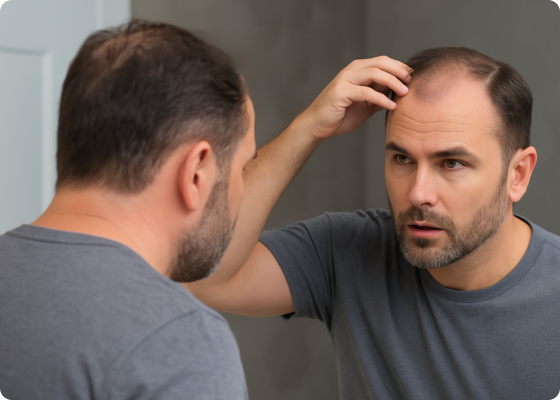
It usually starts quietly. A few more strands than normal on your pillow, a hairline that looks slightly different in a photo, or a patch at the crown that catches you off guard under bright bathroom lighting. By the time most men start asking questions, the process has already been underway for a while.
The instinct is to blame your father's side of the family and move on. Genetics are a major factor, but they're rarely the whole story. Several other causes, some obvious, some genuinely surprising, can trigger or accelerate hair loss in men, and many of them are more treatable than you might think.
Here are six of the most common reasons your hair might be thinning.
1. Genetics and male pattern baldness
This one isn't surprising, but it's worth understanding properly rather than just accepting as a death sentence for your hair.
Male pattern baldness, or androgenetic alopecia, accounts for around 95% of hair loss in men. The underlying mechanism is a genetic sensitivity to dihydrotestosterone (DHT), a hormone derived from testosterone. In men whose follicles carry this sensitivity, DHT gradually shrinks the follicle over time, shortening the growth cycle until the hair produced becomes so thin and short it's barely visible, and eventually disappears altogether.
The classic signs are a receding hairline that takes on an M-shape, thinning at the crown, or both progressing simultaneously. What matters most here is timing. Treatments like finasteride and minoxidil are significantly more effective when started early, while follicles are weakened but still functional, than after years of unchecked miniaturization.
2. Chronic stress
Stress-related hair loss is one of the most misunderstood causes of thinning in men, largely because the timing is so confusing. The shedding doesn't happen during the stressful period; it happens two to three months afterward, once the body has had time to respond.
What occurs is called telogen effluvium. A significant physiological or emotional stressor, whether that's illness, surgery, a period of intense anxiety, or even something like post-COVID recovery, can force a large number of follicles into the resting phase simultaneously. When those follicles eventually shed, the volume of hair loss can be alarming.
The good news is that telogen effluvium is usually temporary. Once the underlying stress is resolved, the hair cycle tends to normalize and regrowth follows. The more important issue is whether the shedding is masking a concurrent pattern of genetic hair loss that also needs to be addressed.
3. Nutritional deficiencies
Hair follicles are among the most metabolically active structures in the body. They demand a steady supply of specific nutrients to sustain a normal growth cycle, and when that supply runs short, they're one of the first things the body deprioritizes.
Deficiencies in iron, vitamin D, zinc, and biotin are all commonly associated with increased shedding and reduced hair density. Iron deficiency in particular is often overlooked in men because it's more frequently associated with women, but it's a real contributor to hair loss regardless of gender.
The signs are usually diffuse thinning across the whole scalp rather than the patterned recession typical of androgenetic alopecia, along with hair that appears dull or breaks easily. A simple blood panel can identify deficiencies before you start guessing at supplements. Addressing a genuine deficiency through diet or targeted supplementation can meaningfully reduce shedding over the following months.
4. Hormonal imbalances beyond DHT
DHT tends to dominate the conversation around hormones and hair loss, but it's not the only hormonal factor worth considering.
Thyroid dysfunction is a significant and frequently missed cause of hair thinning in men. Both an overactive and underactive thyroid can disrupt the hair growth cycle, causing diffuse shedding that doesn't follow the predictable pattern of genetic hair loss. Low testosterone has also been associated with reduced hair density in some men, which creates a somewhat counterintuitive picture given that high DHT activity is the main driver of pattern baldness.
If your hair loss is accompanied by fatigue, unexplained weight changes, sensitivity to temperature, or shifts in mood and energy, it's worth getting a comprehensive hormone panel done rather than assuming the cause is purely genetic.
5. Scalp health and inflammation
The condition of your scalp directly affects what your follicles can produce. A chronically inflamed scalp creates a hostile environment that disrupts the growth cycle, reduces blood flow to the follicle, and accelerates shedding.
Seborrheic dermatitis, scalp psoriasis, and fungal infections are common culprits. These conditions don't just cause discomfort; they create persistent micro-inflammation around the follicle base that, over time, compounds whatever other hair loss factors are already present. Persistent itching, flaking, redness, or a feeling of scalp tightness are all signs worth investigating rather than managing with a generic shampoo.
Treating the underlying scalp condition, whether through medicated shampoos or a dermatologist-recommended protocol, removes one layer of stress on follicles that may already be under pressure from genetics or hormones.
6. Medications and underlying health conditions
Sometimes the answer to why your hair is thinning is sitting in your medicine cabinet. A number of commonly prescribed medications list hair loss as a side effect, including certain antidepressants, blood thinners, retinoids, and chemotherapy drugs. The mechanism varies, but the effect is generally a disruption of the normal hair growth cycle.
Beyond medications, systemic conditions like diabetes, lupus, and severe anemia can interfere with the circulation and nutrient delivery that follicles depend on. Hair loss in these contexts is often a signal that something else needs attention first.
If you suspect a medication is contributing to your thinning, the right move is to speak with your prescribing doctor rather than stopping it abruptly. In many cases, an alternative can be found or a concurrent treatment introduced to manage the shedding.
What to do next
Hair loss in men rarely has a single cause. More often it's a combination of genetic predisposition, hormonal activity, and lifestyle or health factors that together push the hair cycle in the wrong direction. Identifying which of these apply to your situation is the starting point for any treatment that's actually going to work.
If you've reviewed the factors above and still can't pinpoint the cause, or if thinning is progressing faster than expected, a consultation with a dermatologist or trichologist is a worthwhile investment. The earlier the diagnosis, the more treatment options remain on the table.




.svg)